
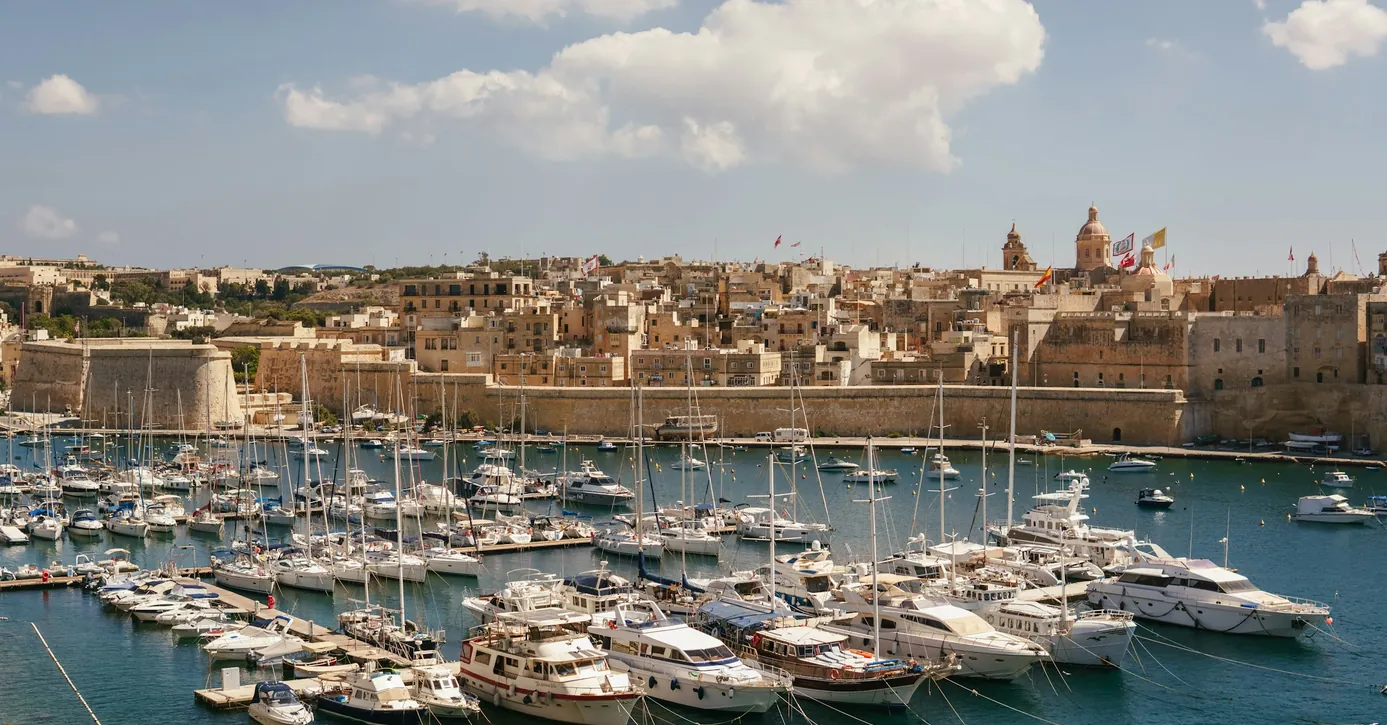
A yacht can fly the Maltese flag whether it belongs to an Italian entrepreneur, a German family or a company incorporated in the Cayman Islands. That openness is one reason why Malta’s ship registry, by Transport Malta’s own description, is the largest in Europe. The flag, however, is only one of the decisions an owner has to make. Who owns the yacht, how it will be used and where its VAT has been paid weigh at least as much, and that is where most of the costly mistakes are made. This guide covers the whole picture, with the rules as they stand after the changes introduced in 2025 and 2026.
Malta yacht registration: the summary
A yacht of at least 6 metres can be registered in Malta by Maltese citizens, by citizens of the EU, EEA, Switzerland and the UK, by Maltese companies and by foreign companies. Owners who are not resident in Malta must appoint a resident agent. Provisional registration lasts six months and has the same effect as permanent registration. The flag has no bearing on VAT: a yacht used in EU waters by an EU resident needs VAT-paid status, whatever flag it flies.
Why owners choose the Maltese flag
Malta is an EU member state, so a Maltese yacht flies an EU flag. The register sits on the white list of the Paris MoU (16th in the ranking published in July 2026) and on the Tokyo MoU High Performance List. For an owner this means a low-risk profile at port state inspections, both in the Mediterranean and further afield.
Some features of the register matter in day-to-day use. Master and crew can be of any nationality, and foreign certificates of competency only need a Maltese endorsement. Mortgages are recorded as soon as the documents are filed, rank by date and time of recording and are an executive title, which is why lenders financing a purchase are comfortable with the Maltese flag. Nor does the law require the yacht to be in Malta to be registered: surveys are carried out by appointed surveyors around the world, declarations can be signed before a Maltese consul or a commissioner for oaths, and since May 2026 the Registry can waive the apostille on documents signed abroad when a Maltese practitioner files a declaration of authenticity. Certificates of registry have been issued in electronic form since June 2025.
Who can register a yacht in Malta
The Merchant Shipping Act (Cap. 234) and the Ships Eligible for Registration Regulations list the persons qualified to own a Maltese ship. The list is closed, so anyone not on it has to go through a company.
| Owner | Can register? | Condition |
|---|---|---|
| Maltese citizen | Yes | None |
| EU, EEA, Swiss or UK citizen resident in Malta | Yes | None |
| EU, EEA, Swiss or UK citizen not resident in Malta | Yes, as an “international owner” | Resident agent in Malta |
| Maltese company | Yes | Place of business in Malta |
| Foreign company, from any country | Yes, as an “international owner” | Resident agent in Malta |
| Individual from outside the EU, EEA, Switzerland and the UK | Not directly | Through a Maltese or foreign company |
The resident agent must be habitually resident in Malta, acts as the Registry’s point of contact and represents the owner before the Maltese courts. An international owner also accepts the jurisdiction of those courts. Since January 2026 resident agents have been bound by a mandatory Code of Standards (Merchant Shipping Notice 203) that requires customer due diligence, sanctions screening and enhanced checks on beneficial owners. In practice, expect to provide the same documents a bank would ask for.
Private or commercial yacht
Transport Malta defines a private (pleasure) yacht as one used solely by its owner, carrying no passengers for payment and not engaged in trade. A commercial yacht is used for sport or pleasure on a commercial basis and carries no more than 12 passengers. If you plan to charter the yacht, even for a few weeks a year, it has to be registered and certified as commercial.
| Yacht | Applicable code |
|---|---|
| Private, under 500 GT | No mandatory code; voluntary compliance with the CYC is recommended |
| Private, 500 GT and over | Commercial Yacht Code 2025 “as far as reasonable and practicable”, with an initial survey |
| Commercial, hull length from 12 m to under 24 m | Small Commercial Yacht Code (sCYC 2024), in force since 1 April 2024 |
| Commercial, 24 m and over, up to 12 passengers | Commercial Yacht Code 2025 (CYC 2025), in force since 1 July 2025 |
| 13 to 36 passengers | Passenger Yacht Code |
CYC 2025 replaced the 2020 edition. Yachts certified under CYC 2020 must comply with the new code by their first renewal survey after 31 December 2025. The Commercial Yacht Certificate is valid for five years. On the lower limit, Transport Malta’s own sources are not aligned: the Superyacht Registration web page still says 15 metres, while the Guide to Ship Registration (2025/26 edition) and the Small Commercial Yacht Code use 12 metres of hull length. For a yacht between 12 and 15 metres, confirm the position with the Registry before planning a charter business.
Commercial registration also opens the door to Malta’s tonnage tax regime, which we cover further down.
The registration process step by step
Registration happens in two stages. Provisional registration can be completed quickly and already gives the yacht Maltese nationality. The file is then completed with the documents from the previous registry and the survey certificates.
- Name and application. The Registry approves the proposed name. The application comes with proof that the owner qualifies (for a company, its incorporation documents) and, where needed, the appointment of the resident agent.
- Provisional registration. After the declaration of ownership, the tonnage certificate where applicable, the application for the radio station licence and payment of the registration fee and first annual fees, the Registry issues a provisional certificate valid for six months. It can be extended for up to six more months on good cause.
- Within one month (extendable by two): the bill of sale, or the builder’s certificate for a new yacht, and evidence that the previous registry has been closed.
- Within six months: the certificate of survey and the tonnage certificate issued by an appointed surveyor or a recognised organisation, evidence of marking, the CE certificate where applicable and, for commercial yachts, the certificates required by the relevant code.
- Permanent registration. Once the file is complete the yacht is permanently registered. The certificate of registry is renewed every year on the anniversary date, when the annual fees fall due.
If the statutory certificates are missing, the Registry issues only a non-operational certificate: the yacht is Maltese but cannot operate. All requirements must be met within twelve months of provisional registration. Transport Malta publishes no official turnaround times, but with a complete file provisional registration is a matter of days.
How old can the yacht be?
Since the 2025 amendment to the Merchant Shipping Act (Act I of 2025), a vessel completed more than 20 years before the year of the first application can only be registered with the express permission of the Registrar-General. The threshold used to be 25 years. The Registrar can also require an inspection before provisional registration for any vessel, whatever its age. Many guides online still say that pleasure yachts face no age limit in Malta; they were written before the amendment. For an older yacht, plan for an inspection and a longer timeline.
Owning the yacht through a Maltese company
Many owners hold their yacht through a single-purpose company. The reasons are practical:
- it is the only route open to individuals from outside the EU, EEA, Switzerland and the UK;
- it keeps the yacht and its liabilities apart from the owner’s other assets;
- a Maltese company is itself a qualified owner, so it does not need a resident agent, provided it has a place of business in Malta;
- if the yacht is chartered, the income is taxed in the company, and Malta’s shareholder refund system can lower the overall tax burden, depending on the structure and on meeting the conditions for the refund. We explain the mechanism in our guide on how Malta’s 5% corporate tax works.
A private yacht generates no income, so the company that owns it has little to tax. Two rules deserve attention. If a director or employee uses the company’s yacht privately, Malta taxes that use as a fringe benefit, valued at 12% a year of the higher of cost and market value, plus the running costs paid by the company. And since 1 January 2026 Malta charges VAT at open market value on transactions between related parties when one of them cannot fully recover VAT, and treats free private use of company assets as a taxable supply. Both rules can come into play when the company lends or leases the yacht to its own shareholder.
Setting up the company follows the usual steps described in our guide on how to register a limited company in Malta. If you need local directors or a registered office, see our director and company secretary service.
VAT: what the flag does not decide
The most common misunderstanding concerns VAT. The flag, the registry and the owner’s nationality do not determine a yacht’s VAT position; its customs status does. A yacht used in EU waters by an EU resident must have Union status with VAT paid, as the European Commission restated in its guidance note on pleasure craft of 30 April 2026. A Maltese-flagged yacht also cannot use temporary admission, the regime that allows yachts registered outside the EU, owned and used by non-EU residents, to stay in the EU for up to 18 months without paying VAT.
A yacht coming from outside the EU and released for free circulation in Malta pays import VAT at the standard rate of 18%, plus any customs duty, unless a relief applies, such as returned goods relief for a yacht that already had Union status before leaving the EU. When the yacht is for private use, that VAT cannot be recovered. A yacht with Union status and VAT already paid in another EU country is not imported at all, and it keeps that status under the Maltese flag.
Malta Yacht Registration VAT Deferral Mechanism Explained (Updated 09/2026)
A VAT-registered importer bringing a yacht into Malta for commercial use can avoid paying import VAT at customs. The essentials:
- Legal basis: article 60(1)(c) of the VAT Act allows imported goods to be released without payment of VAT with the authorisation of the Commissioner, under the conditions and against the security the Commissioner sets.
- It is meant for yachts that will be chartered or leased. On a yacht imported for private use, import VAT is paid and cannot be recovered.
- Without deferment, a commercial importer pays the VAT at customs and recovers it later through the VAT return. Deferment removes that cash outlay.
- The importer must be registered for VAT in Malta and apply in writing. A Maltese company needs no guarantee, and neither does an EU company that appoints a VAT representative in Malta under article 66(2)(b). A company from outside the EU has to provide a bank guarantee.
- The tax authority has not published guidelines specific to yachts, so the conditions are the ones written in the individual authorisation. Check them before the purchase.
The Maltese yacht leasing scheme today
Until 2018 Malta allowed lease arrangements in which the taxable share was fixed according to the length of the yacht, with effective VAT rates that could drop to around 5.4%. The European Commission opened infringement proceedings in March 2018 and Malta changed the system: for leases commencing on or after 1 November 2018, VAT follows the actual use and enjoyment of the yacht outside EU territorial waters. The Commission closed its case against Malta in October 2020. The guidelines currently in force were issued by the Maltese tax authority on 2 November 2023.
In practice the lessor charges VAT in full at the start of the lease. After the first VAT period (or the first two, if the lease starts less than 30 days before the end of the period), it obtains logs, GPS or AIS data from the lessee, calculates the actual share of use within EU waters and adjusts the VAT already charged in the following VAT return. The same calculation is repeated for every later period. Use outside EU waters counts only for the time it can actually be identified and documented. If the yacht spends 40% of its time in EU waters, the VAT borne on the lease payments comes down to 40% of 18%, so 7.2%. The saving therefore depends on where the yacht actually sails and on the quality of the records kept on board.
12% VAT on short charters
Since 1 January 2024 the hire of a pleasure boat whose place of supply is Malta is taxed at 12% instead of 18%. For short-term hire, the place of supply is where the customer takes physical possession of the boat. The reduced rate covers up to 35 days of hire to the same customer, adding up any hires of the same or similar boats to that customer in the previous twelve months; the days beyond that are taxed at 18%. It does not apply to seats sold individually on shared trips. For charter operators working out of Malta this is a direct price advantage.
Commercial yachts and tonnage tax
A yacht registered and certified as commercial, carrying up to 12 fare-paying passengers, can come under Malta’s tonnage tax regime: instead of income tax on its profits, the shipping company pays a tax calculated on the yacht’s tonnage. The European Commission approved the regime in December 2017 (Decision (EU) 2019/1116), and the implementing regulations have applied since 1 May 2018. Private yachts are excluded, as are companies that simply lease yachts to individuals. Under its commitments to Brussels, Malta has to notify the regime again within ten years of the 2017 decision.
Whether tonnage tax beats the ordinary company route depends on the charter income and on how the business is organised. It is one of the first things we look at in a tax assessment for a charter yacht.
Mind your home country
Registering a yacht in Malta does not change your tax obligations where you live. Many countries require residents to report assets and companies held abroad, and most treat a foreign company as resident at home when it is effectively managed from there.
Italy is a good example. An Italian resident has to report a yacht on a foreign register in the RW section of the tax return; if the yacht belongs to a Maltese company, the shares in that company are reported instead and are subject to IVAFE at 0.2%. Since 2024 a company is Italian tax resident if, for most of the tax year, its place of effective management (the continuous and coordinated taking of strategic decisions) or its day-to-day management is in Italy. Decisions taken by a shareholder as such do not count, but a shareholder who in practice runs the company from Italy can bring it within the rule. Whether a Maltese company is exposed depends on where, and by whom, it is actually managed. For the structure to hold, the company needs real management in Malta, and the same logic applies to the question of a resident director.
New builds, financed purchases and bareboat charters
A yacht under construction can be registered in Malta. On the strength of a statement from the yard, the Registry issues a provisional non-operational certificate; for commercial yachts the build must also be supervised by a recognised organisation. Since the 2025 amendment, provisional registration of a new build can be extended in steps of up to three years until delivery. The same reform introduced the finance charter instrument as a new form of security, alongside mortgages.
Malta also allows bareboat charter registration, in and out, with compatible registries. Ownership and mortgages stay on the underlying register, and the registration lasts up to two years at a time, renewable. For a sale, the transfer of ownership requires a bill of sale, the declaration of the buyer, payment of all fees due and the consent of any mortgagee if the buyer is not a qualified owner. Deletion from the register is not possible until all dues are paid and every registered mortgagee has consented in writing.
When the Maltese register is not the right choice
For the sake of professional honesty, there are cases where this is not the right route:
- The boat never leaves Maltese waters and you live in Malta. Boats under 24 metres used only in Maltese territorial waters go on the Small Ships Register, which is simpler and requires the owner to be at least 18 with a residential address in Malta.
- The boat is under 6 metres. It cannot be registered under the Merchant Shipping Act.
- You expect the flag to solve the VAT question. It does not. If the yacht has not paid VAT and you are an EU resident, that has to be dealt with separately.
- The owning company would be run entirely from your home country. The yacht will be Maltese, but the company risks being treated as tax resident where you live.
How we can help
We work on the ownership side of the file, the part of a registration that most often needs advice. We set up the Maltese company that will own the yacht, provide the registered address and local officers where needed, coordinate the registration file and look at VAT and tax with you before the purchase rather than after. Start from our page on company incorporation in Malta or get in touch to discuss your yacht.
This article is for general information only and does not constitute legal or tax advice. Thresholds and procedures depend on the specific case and on the law in force: always check with a professional before making decisions.
Can a non-EU citizen register a yacht in Malta?
Not in their own name. Only Maltese citizens and citizens of the EU, EEA, Switzerland and the UK can register a yacht personally. Anyone else has to own it through a company, Maltese or foreign. A foreign company needs a resident agent in Malta.
How long does it take to register a yacht in Malta?
With a complete file, provisional registration takes a matter of days. It is valid for six months, extendable by up to six more, during which the bill of sale, the deletion certificate from the previous registry and the survey and tonnage certificates are filed. Everything must be completed within twelve months.
Can an older yacht be registered in Malta?
Yes, but since the 2025 amendment to the Merchant Shipping Act a vessel completed more than 20 years before the year of the first application needs the express permission of the Registrar-General. The Registrar can also require an inspection before provisional registration, whatever the age of the yacht.
Does the Maltese flag reduce VAT on a yacht?
No. VAT depends on the yacht’s customs status, not on its flag. A yacht used in EU waters by an EU resident must have VAT paid. Malta’s leasing arrangement reduces VAT only in proportion to the time actually spent outside EU waters.
Does the yacht have to come to Malta to be registered?
No. The law does not require the yacht to be in Malta. Surveys can be carried out by appointed surveyors around the world and declarations can be signed before a Maltese consul or a commissioner for oaths.
Can I charter a yacht registered in Malta?
Only if it is registered and certified as a commercial yacht, carrying no more than 12 passengers, under the Small Commercial Yacht Code (12 to 24 metres) or the Commercial Yacht Code 2025 (24 metres and over). The hire of a pleasure boat put at the customer’s disposal in Malta is taxed at 12% for up to 35 days per customer in any twelve months.