Finance Minister Clyde Caruana presented Malta’s Budget for 2027 to Parliament on 26 October 2026. For companies and the self-employed, the Budget speech announces a lower tax rate for small companies on the profits they keep in the business, stricter VAT enforcement, higher fees for employing workers from outside the EU and new levies on tourism.
Most of these measures still need a law or implementing rules, and the speech gives a start date for only some of them. Below we list every measure in the official Maltese text of the speech that concerns businesses, including what the government confirmed will stay as it is, and we flag the points still open.
Budget 2027 for businesses in brief
- Companies with turnover of up to €1 million will be able to pay 25% instead of 35% on profits they retain or reinvest. Profits paid out as dividends stay taxed at 35%.
- A VAT reverse charge is coming to the construction sector, and failures to issue correct VAT invoices or fiscal receipts will carry administrative penalties from €100 to €500.
- A new work permit for a worker from outside the EU will cost €800 instead of €600, plus an infrastructure contribution of €400 a year on new and renewed permits.
- From 1 January 2027 the eco-contribution rises to €8 a night in hotels and other collective accommodation and €10 a night in short lets.
- Income tax rates, the VAT rate and social security contributions do not increase, energy prices stay stable and every current support scheme is renewed for 2027.
25%
tax on retained profits
Companies with turnover up to €1 million, instead of 35%
€800
new non-EU work permit
Was €600, plus €400 a year for infrastructure
€8
eco-contribution per night
€10 in short lets, from 1 January 2027
0
tax rate increases
Income tax, VAT and social security rates stay as they are
A 25% tax rate for small companies
The government will introduce a framework under which companies with a turnover not exceeding €1 million can pay tax at 25% instead of 35%. The minister specified that the reduction applies to profits retained in the company or reinvested. When the company pays the profits out as dividends, the 35% rate still applies.

According to the speech, the measure should reduce the tax burden on smaller companies, make them more competitive and leave them more resources to invest in the business. The minister linked it to the Youth-Led Start-Up Support Scheme launched in 2026 and to young people who decide to set up their own business.
On €50,000 of retained taxable profit, a 25% rate gives €12,500 of tax against €17,500 at 35%. Treat this figure as an illustration until the rules are published.
The measure will operate under conditions and limitations set out in specific rules, so that it fits with the existing system of company taxation. The government has not published those rules yet, and the speech does not say:
- from which year of assessment the reduced rate applies;
- how turnover is measured, including for companies that belong to a group;
- what happens when profits taxed at 25% are distributed in a later year;
- how the reduced rate works with the tax refunds that shareholders can claim on dividends.
The last point matters to companies owned by non-residents. Under Malta’s full imputation system a trading company pays 35%, and when it distributes trading profits its shareholders can claim back six sevenths of that tax. The speech does not mention any change to this system. For a company that distributes its profits, the measure as announced changes nothing. Our guide to the 5% effective tax rate explains how the refunds work.
VAT changes for construction, invoices and food
Reverse charge in the construction sector
For the transactions covered by the new mechanism, the obligation to account for VAT moves from the supplier to the business that buys. The buyer calculates and declares the VAT due on the purchase and can deduct the same VAT if the law allows it.
The government wants to remove the risk of suppliers who collect VAT from their clients and keep it, and to limit refund claims based on false invoices or fictitious transactions. The speech does not list the transactions covered and does not give a start date.
Penalties for incorrect invoices and fiscal receipts
Instead of turning straight to criminal proceedings, the tax administration will apply a system of administrative penalties that builds on the existing compromise penalty mechanism. Within a period of 24 months the penalties are:
Penalties for failing to issue a correct VAT invoice or fiscal receipt, counted within 24 months.
If the business pays the penalty within 30 days, the criminal liability for the failure covered by that penalty is extinguished. Each failure also goes into the risk assessment system of the Malta Tax and Customs Administration. It raises the business’s risk score and with it the chance of being selected for an audit, an inspection or an investigation.
Guidelines on the VAT exemption for food
The government is preparing guidelines on how the VAT exemption on food applies, in particular to ready-to-eat food sold by supermarkets, minimarkets and convenience shops, which compete with each other and with restaurants. The speech presents them as a clarification, so that operators apply the exemption in the same way across the sector. It does not announce a new rate.
Employing workers from outside the EU
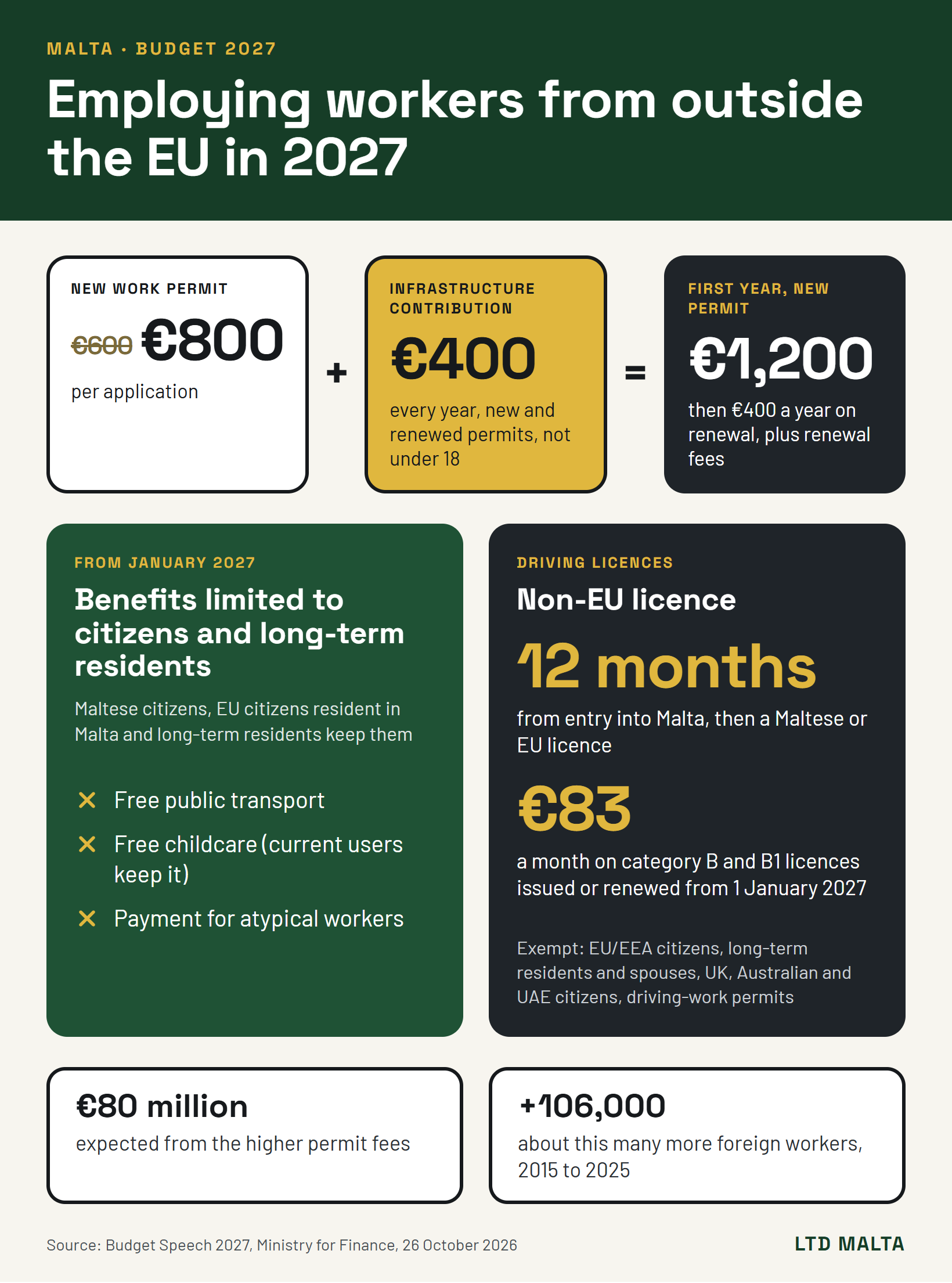
The minister said that the number of foreign workers in Malta grew by about 106,000 between 2015 and 2025, and that they should also contribute to the cost of the infrastructure they use. The Budget raises the fees for work permits of third-country nationals:
- a new application costs €800 per person instead of €600;
- an infrastructure contribution of €400 applies to new applicants and to renewals, is due every year and does not apply to minors under 18;
- many other permits issued by Identità will also cost more, but the speech does not give the amounts.
The government expects these increases to raise about €80 million.
Other measures concern foreign staff and may come up when you recruit:
- from January 2027, free public transport remains only for Maltese citizens, EU citizens resident in Malta and long-term residents;
- the same rule applies to free childcare from next year, but families who already use the service keep it until their children are no longer eligible;
- the same rule applies from 1 January 2027 to the payment for atypical workers;
- a driving licence issued outside the EU can be used for twelve months from entry into Malta. For residence permit holders the period does not restart after leaving and re-entering, and for those who already hold a permit it runs from their last entry before 1 January 2027. After that they need a Maltese or EU licence. Drivers with a residence permit for specific driving work are exempt;
- an administrative charge of €83 a month applies to holders of category B and B1 licences issued or renewed from 1 January 2027. EU and EEA citizens, long-term residents and their spouses, citizens of the United Kingdom, Australia and the United Arab Emirates and drivers with a permit for specific driving work are exempt.
Wages, cost of living and leave
- The national minimum wage rises by €10.41 a week in 2027, cost-of-living adjustment included, under the 2023 agreement between the social partners and the government. The government will reappoint the Low Wage Commission to agree the minimum wage from 2028 onwards.
- The cost-of-living adjustment (COLA) for 2027 is €6.41 a week.
- Employees who start fostering a child get 10 additional working days of leave, equivalent to paternity leave, and the government covers the cost.
- Elite athletes who represent Malta in European or world championships get ten days of paid sports leave. The same applies to the technical and medical staff who travel with them.
- Employees temporarily off work because of mental health problems or domestic violence can receive up to two years of social security contribution credits.
Self-employed people and family taxation
The Super Bonus
The government will pay the Super Bonus in the first quarter of 2027 to everyone eligible, using 2025 as the base year. The speech lists the self-employed among the recipients, together with older people who keep working and part-time workers. The payment is not taxable.
| Income in 2025 | Super Bonus |
|---|---|
| €12,000 or more | €1,000 |
| €11,000 to €11,999 | €925 |
| €10,000 to €10,999 | €875 |
| €9,000 to €9,999 | €800 |
| €8,000 to €8,999 | €725 |
| €7,000 to €7,999 | €650 |
| €6,000 to €6,999 | €575 |
| €2,000 to €5,999 | €500 |
For employees the speech refers to income from employment. For the self-employed it does not say which income counts, so check the official guidance when it comes out.
Lower tax for parents
The Budget confirms the second year of the three-year tax cut for families with children announced in the Budget for 2026. The tables apply to individuals, so they also apply to self-employed parents. The income on which no tax is paid rises as follows:
| Tax computation | Current | 2027 | 2028 |
|---|---|---|---|
| Married, one child | €17,500 | €20,000 | €22,500 |
| Parent, one child | €14,500 | €16,000 | €18,000 |
| Married, two or more children | €22,500 | €30,000 | €37,000 |
| Parent, two or more children | €18,500 | €24,000 | €30,000 |
In all four tables the following bands are taxed at 15% and 25%, and income above €60,000 at 35%. The speech announces no change for single taxpayers or married couples without children.
Separate tax returns for spouses
The government will start a project to reform income tax returns for married couples. As a general rule each spouse would file an individual return on their own income, and couples who prefer a joint return could still choose it where the law allows. The speech gives no date.
Tourism, transport and yachting
- From 1 January 2027 the eco-contribution is €8 a night in collective accommodation, up to €64 per person, and €10 a night in short-let apartments, up to €80 per person. Only guests over 18 pay it. English language schools will no longer have to pay it on accommodation. The government expects about €182 million.
- Cruise passengers who disembark in Malta and re-embark on the same ship will pay an eco-contribution of €10. Passengers whose cruise starts in Malta do not pay it.
- Visitors to Comino will pay a €5 eco-contribution through the existing booking system for the Blue Lagoon.
- Fast ferry fares paid by tourists rise by €3 per trip.
- The government will review the incentives paid to airlines, with more weight on the shoulder and winter months and on destinations that bring higher-quality tourism. It is also in talks with several airlines about a strategic partner for KM Malta Airlines.
Fares on the Gozo ferry go up for passengers who do not live in Malta:
| Non-resident fare | Current | Proposed |
|---|---|---|
| Adult | €4.65 | €11.00 |
| Child | €1.15 | €7.00 |
| Vehicle and driver | €15.70 | €22.00 |
| Vehicle, driver and adult passenger | €20.35 | €33.00 |
| Vehicle, driver, adult and child | €21.50 | €40.00 |
Registration fees for boats from 10 to 24 metres
To recover part of the subsidy on marine fuel, the annual registration fees for vessels from 10 to 24 metres will rise according to length. Vessels over 24 metres cannot take subsidised fuel by law, and professional fishermen and vessels under 10 metres are excluded. The additional annual amounts in the speech for yachts under 50 gross tonnes are:
| Length | Additional annual fee |
|---|---|
| 10 to under 12 m | €300 |
| 12 to under 15 m | €350 |
| 15 to under 18 m | €650 |
| 18 to under 21 m | €1,800 |
| 21 to under 24 m | €2,600 |
The table in the speech gives the same amounts for other vessels, and for commercial yachts it lists amounts from €350 to €2,600. The government expects about €3 million from the measure. Our guide to yacht registration in Malta covers the rest of the procedure.
Property: sales of airspace
The government found that some arrangements involving the sale of airspace lead to tax being calculated on only part of the real value of a finished property. It will introduce measures that require fuller disclosure of the total consideration agreed for these developments, strengthen valuation and verification procedures and tax transactions according to their economic substance. The measures will also cover structures that involve intermediaries or developers who do not appear in the deed of transfer.
The new framework will apply only to future transactions, after consultation with the parties concerned. Developers, buyers and professionals in the sector should follow the consultation.
What stays the same in 2027
Confirmed for 2027
- The government will not raise income tax rates, the VAT rate or social security contributions. Contribution rates and the retirement age stay the same.
- For companies outside the new 25% framework, and for all distributed profits, the corporate tax rate stays at 35%. The speech does not mention any change to the refund system.
- Electricity, gas and fuel prices stay stable. The subsidies cost about €392 million in 2026, and the government expects to spend around €400 million in 2027.
- All the support schemes in place in 2026 will be renewed for 2027, in every area.
- Malta Enterprise will continue its schemes for businesses and industry, with incentives for digitalisation, automation, higher value-added investment and new or existing niche sectors. The speech does not list amounts or conditions.
- In financial services, the regulator and the MFSAC will keep working on the regulatory and administrative framework. The speech names family offices, crypto companies, fintech and aircraft leasing as growing sectors.
The government forecasts real growth of 3.8% in 2027 after 4.1% in 2026, a deficit of 2.6% of GDP in both years and public debt at 46.8% of GDP in 2027.
Measures already in law for 2027
Some changes that start in 2027 were already approved with the Budget Measures Implementation Act, 2026 (Act III of 2026) and do not depend on this Budget:
- a deduction of 175% of expenditure on research, development and innovation, applicable from the year of assessment 2027. It applies from a date that the Finance Minister sets by notice in the Government Gazette, and rules will define the qualifying activities;
- from 1 January 2027, an online marketplace or platform that facilitates supplies of goods within the EU by a seller established outside the EU is treated for VAT purposes as having bought and supplied those goods itself.
What to check now
- If your company has a turnover close to €1 million and reinvests its profits, wait for the rules before changing your dividend policy.
- If you work in construction, prepare to adapt contracts and invoicing once the scope of the reverse charge is published.
- Check how your business issues VAT invoices and fiscal receipts. A penalty applies from the first failure and also raises your risk score.
- If you employ workers from outside the EU, plan for €800 plus €400 a year for each new permit and €400 a year for each renewal, and check which employees drive on a non-EU licence.
- If you run a hotel, a guesthouse or short lets, update your prices and booking systems for the new eco-contribution from 1 January 2027.
- If you are planning to set up a company in Malta, take the 25% rate into account only once the rules confirm who qualifies and from when. For an assessment based on your figures, see our tax advice service.
Frequently asked questions
Will every company with a turnover under €1 million pay 25% from 2027?
The speech announces the 25% rate for companies with a turnover not exceeding €1 million, only on profits that are retained or reinvested. Conditions and limitations will be set in rules that have not been published yet, and profits paid out as dividends stay taxed at 35%.
When does the 25% rate start?
The speech does not give a start date. The rate will apply once the implementing rules are in force. We will update this article when they are published.
Does Budget 2027 change the tax refunds for shareholders of Maltese companies?
The speech does not mention any change to the refund system. Distributed profits remain taxed at 35% at company level.
Is VAT going up in Malta in 2027?
No. The government said it will not raise the VAT rate. The VAT measures concern a reverse charge in construction, administrative penalties for incorrect invoices and fiscal receipts, and guidelines on the food exemption.
Do self-employed people receive the Super Bonus?
Yes. The speech includes the self-employed among the recipients. The payment arrives in the first quarter of 2027, is based on 2025 income and ranges from €500 to €1,000.
Sources
- Ministry for Finance, Diskors tal-Budget 2027, 26 October 2026 (PDF, in Maltese)
- Act III of 2026, Budget Measures Implementation Act, 2026