

Over the past few days, several websites have reported that foreign residents in Malta will pay a minimum tax of €35,000 a year from January 2027. Many foreign nationals living in Malta read these reports as a change to their own tax position.
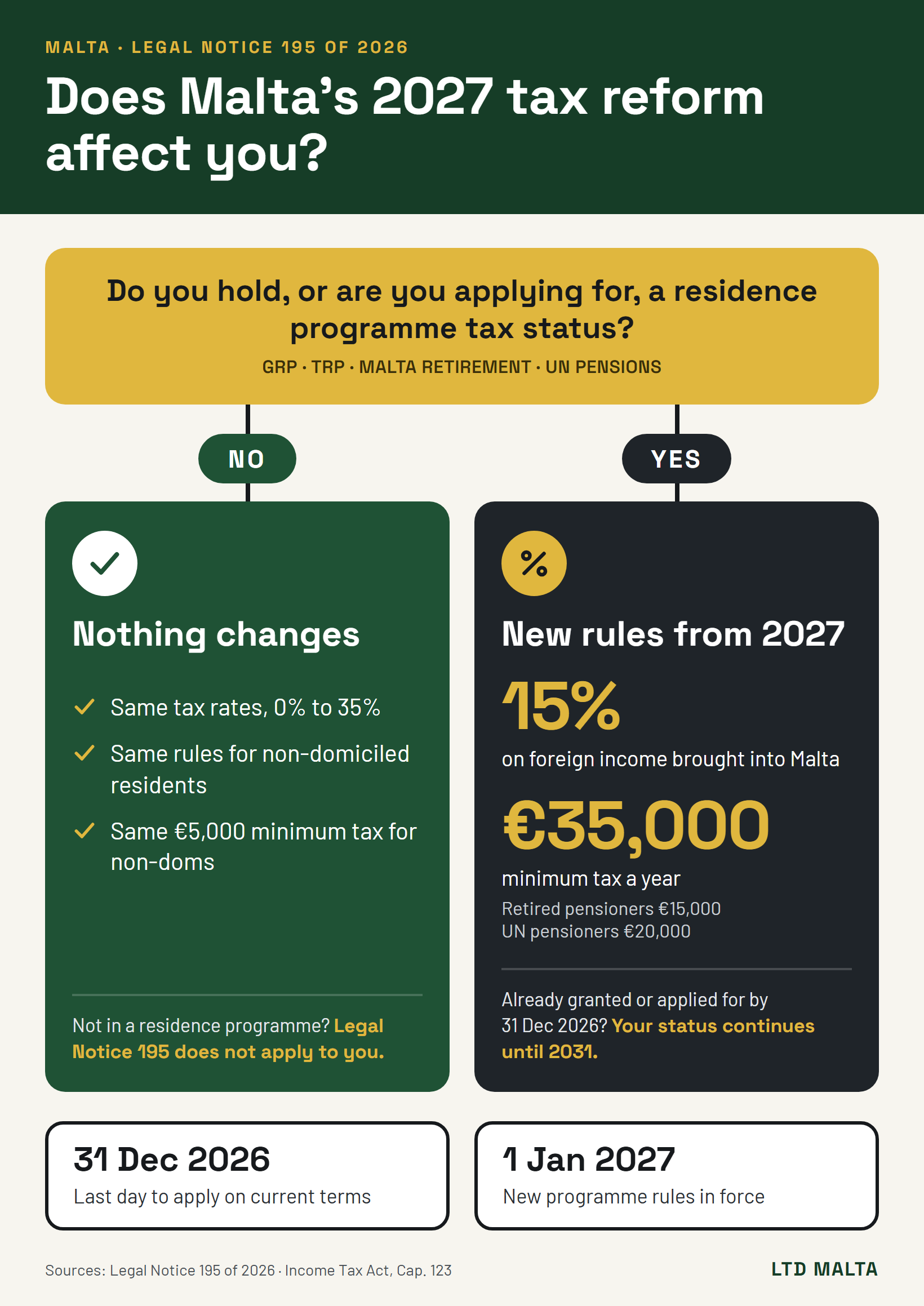
The reports refer to Legal Notice 195 of 2026, the Individual Tax Programme Rules, 2026. These rules cover only individuals who apply for a special tax status under one of Malta’s residence tax programmes and obtain it from the Commissioner for Tax and Customs. If you live in Malta under the ordinary tax rules and have never applied for one of these programmes, your tax treatment stays the same.
The new rules in brief
- Legal Notice 195 of 2026 comes into force on 1 January 2027.
- It applies only to people who apply for a special tax status under Malta’s residence tax programmes and obtain it.
- New beneficiaries pay a minimum tax of €35,000 a year (€15,000 for retired pensioners and €20,000 for UN pensioners).
- Statuses granted, or applied for, by 31 December 2026 continue until 31 December 2031.
- If you live in Malta under the ordinary rules, your tax position does not change: residence, domicile, the remittance basis and the €5,000 minimum tax for non-domiciled residents stay as they are.
What Legal Notice 195 of 2026 does
The Minister for Finance made the rules under articles 56(23) and 96 of the Income Tax Act (Cap. 123). The Government Gazette published them on 14 July 2026, and they come into force on 1 January 2027.
The rules regulate a “special tax status” that the Commissioner grants on application. They set out four categories:
- global resident status, for nationals of countries outside the EU, the EEA and Switzerland;
- EU, EEA and Swiss resident status;
- retired pensioner status;
- UN pensioner status, for people who receive a pension from the United Nations Joint Staff Pension Fund or a widow’s or widower’s benefit from it.
Maltese tax firms describe the new rules as a single framework that replaces four existing programmes: the Global Residence Programme, The Residence Programme, the Malta Retirement Programme and the United Nations Pensions Programme.
The status requires an application. You have to apply through an authorised registered mandatary, meaning an advocate, legal procurator, notary or warranted accountant registered with the Commissioner, and pay a non-refundable fee of €8,500. The 15% rate then applies to foreign income that you, your spouse and the children covered by your status bring into Malta. The status concerns tax only. The rules say nothing about residence permits, so your right to live in Malta depends on the immigration rules that apply to you.
What changes for new applicants from 2027
A beneficiary pays a flat 15% on foreign income remitted to Malta and can claim relief for tax paid abroad. Any other income of the beneficiary and of the family members covered is taxed separately at 35%.
The main changes concern the minimum tax and the property requirement. A property bought for less than €700,000 before the rules come into force can still count as a qualifying property, as the Commissioner determines in published guidelines.
| Previous programmes | Individual Tax Programme from 2027 | |
|---|---|---|
| Minimum tax, global and EU/EEA/Swiss residents | €15,000 a year | €35,000 a year |
| Minimum tax, retired pensioners | €7,500, plus €500 for each dependant | €15,000 a year |
| Property purchase (GRP) | €275,000, or €220,000 in Gozo and the south of Malta | €700,000 anywhere in Malta or Gozo |
| Annual rent (GRP) | €9,600, or €8,750 in Gozo and the south of Malta | €14,000 anywhere in Malta or Gozo |
UN pensioners follow their own rules. Their UN pension or survivor’s benefit received in Malta is exempt, other foreign income remitted to Malta is taxed at 15%, and the minimum tax is €20,000. They must receive at least 40% of the UN pension in Malta. Retired pensioners must receive their whole pension in Malta, and the pension must make up at least 75% of their chargeable income.
Beneficiaries pay the minimum tax by 30 April of the year before the year of assessment, together with a return that shows they still meet the conditions. The Commissioner does not refund it. For global, EU/EEA/Swiss and retired pensioner status, the full minimum is due both in the year the status starts and in the year it ends.
The status lasts five years. Beneficiaries can renew it for further five-year periods by paying a €2,500 fee. To keep it, they must live in the qualifying property as their main home, hold health insurance and a valid travel document, have stable resources, communicate in Maltese or English, and avoid spending more than 183 days a year in any other country. They must also not be domiciled in Malta and must not intend to become domiciled there within five years.
People who already benefit from a programme
Rule 3(3) states that any special tax status granted by 31 December 2026, including one requested in an application received by that date, continues to apply until 31 December 2031. Maltese tax firms read this as keeping current beneficiaries, and anyone who applies before the end of 2026, on the existing thresholds until the end of 2031.
The clause on long-term and permanent residents
Some reports also say that foreign residents who become long-term or permanent residents will pay ordinary Maltese tax on all their income. This refers to rule 5(5).
Under rule 5(5), an individual who holds or applies for long-term resident status (available to non-EU nationals) or the right of permanent residence (available to EU nationals) pays tax at the ordinary rates on income from Malta and from abroad, whether or not the income reaches Malta. The same rule requires the beneficiary’s mandatary to check every year whether the beneficiary or a dependant has obtained or applied for one of these statuses, and to tell the Commissioner by 30 April. A mandatary who fails to do so pays a €10,000 penalty. Rule 6 then ends the special tax status of a beneficiary who becomes a long-term or permanent resident.
Since 2018, article 4(1) of the Income Tax Act has applied the same principle to every resident: a long-term resident, or a holder of a permanent residence certificate or card, loses the remittance basis from the year the status is granted. The Global Residence Programme Rules (S.L. 123.148, rule 5(4)) already contain similar wording. Rule 5(5) carries the principle into the new programme, so a beneficiary cannot keep the 15% flat rate after obtaining a permanent residence status.
The tax regime for ordinary residents
Legal Notice 195 does not amend the Income Tax Act, the ordinary tax rates or the rules on residence and domicile. If you live in Malta without a special tax status, the following rules continue to apply to you.
Malta taxes individuals according to residence and domicile. You are ordinarily resident if you live in Malta in the regular course of your life. Your domicile is the country you regard as your permanent home. It depends on the facts of your case, not on your nationality, and a foreign national who moves to Malta stays non-domiciled as long as they do not make Malta their permanent home.
- If you are resident and domiciled in Malta, you pay tax on your worldwide income.
- If you are resident but not domiciled, you pay tax on income arising in Malta and on foreign income you bring into Malta. Malta does not tax foreign income you keep abroad, or foreign capital gains, even when you bring them into Malta.
- If you are a long-term resident, or hold an EU permanent residence certificate or card, the remittance basis does not apply: you pay tax on your worldwide income from the year the status was granted. Article 4(1) of the Income Tax Act has provided this since 2018, and Legal Notice 195 does not change it.
- If your spouse is ordinarily resident and domiciled in Malta, the remittance basis does not apply to you and you pay tax on your worldwide income.
- If you are not resident, you pay tax only on income and gains arising in Malta.
A resident who is not domiciled and has foreign income of €35,000 or more that does not all reach Malta pays a minimum tax of €5,000 a year. Married couples living together add their foreign income together for the €35,000 test. Maltese tax already paid counts towards the €5,000, and anyone subject to another minimum tax under Maltese law is excluded. Legal Notice 195 leaves this rule unchanged.
Malta taxes chargeable income at progressive rates from 0% to 35%. Each rate applies only to the part of income that falls within its band. These are the single rates for the 2026 basis year:
| Chargeable income | Rate |
|---|---|
| Up to €12,000 | 0% |
| €12,001 to €16,000 | 15% |
| €16,001 to €60,000 | 25% |
| Over €60,000 | 35% |
Married couples and parents have their own tables. Since 2026 the Malta Tax and Customs Administration has applied seven rate structures, based on marital status and the number of children.
Programme beneficiaries and ordinary residents compared
Covered by Legal Notice 195
Special tax status holders
- 15% on foreign income brought into Malta
- Minimum tax of €35,000 a year (€15,000 retired pensioners, €20,000 UN pensioners)
- Property bought for at least €700,000 or rented for at least €14,000 a year
- Application through an authorised mandatary, with an €8,500 fee
Not covered
Ordinary residents
- Progressive rates from 0% to 35%
- If not domiciled, foreign income taxed only when brought into Malta (except long-term and permanent residents)
- €5,000 minimum tax only with foreign income of €35,000 or more not fully brought into Malta
- No change from Legal Notice 195
What you should check
- If you live in Malta and have never applied for a residence tax programme, Legal Notice 195 does not change your tax position.
- If you already benefit from the GRP, The Residence Programme, the Malta Retirement Programme or the UN pensions programme, your status continues until 31 December 2031. Plan the move to the new rules before that date.
- If you are considering one of these programmes, an application received by 31 December 2026 falls under the transitional rule. Applications made from 2027 follow the new thresholds.
- If you hold a special tax status and are thinking about applying for long-term or permanent residence, check the tax effect first, because your special status will end.
The Budget for 2027
Finance Minister Clyde Caruana presented the Budget for 2027 on 26 October 2026. The speech announces no change to the Individual Tax Programme Rules, to the remittance basis or to the €5,000 minimum tax for non-domiciled residents. The measures for companies, employers and the self-employed are in our summary of Malta’s Budget 2027 for businesses.
Frequently asked questions
I am a foreign national living in Malta. Will I pay a minimum of €35,000 from 2027?
Only if you apply for and obtain global resident or EU, EEA and Swiss resident status under the Individual Tax Programme Rules. Residents taxed under the ordinary rules pay tax at the ordinary rates, and the €35,000 minimum does not apply to them.
I am not domiciled in Malta and bring part of my foreign income here. Does anything change?
Legal Notice 195 leaves the remittance basis and the €5,000 minimum tax for non-domiciled residents as they are.
I obtained GRP status in 2023. Will I pay €35,000 from 2027?
Rule 3(3) keeps any status granted by 31 December 2026 in force until 31 December 2031, and Maltese tax firms read it as preserving the current thresholds for that period. Confirm your position with your authorised mandatary.
Where can I read the official text?
Legislation Malta publishes Legal Notice 195 of 2026 on legislation.mt. You will find the link in the sources at the end of this article.
Sources
- Legal Notice 195 of 2026, Individual Tax Programme Rules, 2026
- Global Residence Programme Rules, S.L. 123.148