
- Is Malta’s Corporate Tax Really 5%?
- The Basic Malta Tax Refund Mechanism
- Requirements to Achieve the 5% Effective Tax Rate in Malta
- When the 5% Effective Rate May Not Apply
- Simple Example: How the 5% Effective Tax Rate Is Calculated
- What Is the 6/7ths Tax Refund?
- Important: The Company Pays 35%, Not 5%
- When Is the 5% Effective Tax Rate Available?
- Does the 5% Tax Rate Apply to All Malta Companies?
- Does the Shareholder Need to Be Non-Resident?
- Is the 5% Rate Final?
- Malta’s Full Imputation System Explained
- Why Does Malta Use This System?
- Practical Timeline: When Is the Refund Claimed?
- What About Fiscal Units and Tax Consolidation?
- Does Malta’s 5% System Still Exist in 2026?
- Who Can Benefit Most from Malta’s 5% Effective Tax System?
- Substance Requirements: Why They Matter
- Banking and the 5% Tax System
- Example: Trading Company with Foreign Shareholder
- Example: Passive Royalty Income
- Compliance Requirements for Malta Companies
- Advantages of the Malta Tax Refund System
- Disadvantages and Practical Considerations
- Is Malta a Tax Haven?
- Malta 5% Tax: Key Takeaways
Malta is often associated with an attractive 5% effective corporate tax rate for companies. However, this figure is frequently misunderstood.
A Maltese company does not simply pay 5% tax directly on its profits. In most cases, the company is first taxed at the standard corporate income tax rate of 35%. The 5% effective rate is normally achieved through Malta’s full imputation system and shareholder tax refund mechanism, which may allow shareholders to claim back part of the tax paid by the company after profits are distributed as dividends.
This means that the Maltese tax system is not a simple low-tax regime. It is a structured system where the company pays tax, dividends are distributed, and eligible shareholders may request a refund of part of the tax paid.
In this guide, we explain how the Malta 5% tax system works, who can benefit from it, what the 6/7ths refund means, and what business owners should know before opening a company in Malta.
Is Malta’s Corporate Tax Really 5%?
The official corporate tax rate in Malta is 35%, as confirmed by the Malta Tax & Customs Administration. Companies are generally subject to income tax at this flat rate on their chargeable income.
The 5% figure comes from Malta’s tax refund system. Under this system, once a Maltese company pays tax and distributes dividends, shareholders may be entitled to claim a refund of part of the tax paid by the company.
For many trading companies, the most common refund is the 6/7ths refund. This can reduce the effective tax burden in Malta from 35% to approximately 5%, assuming the relevant conditions are met.
So, in practical terms:
- Malta headline corporate tax rate: 35%
- Possible refund to shareholders: 6/7ths of the Malta tax paid
- Possible effective tax leakage: approximately 5%
The Basic Malta Tax Refund Mechanism
The Malta 5% effective tax rate normally works in four steps:
- The Maltese company generates taxable profits.
- The company pays corporate tax in Malta at 35%.
- The company distributes after-tax profits as dividends to its shareholders.
- Eligible shareholders claim a refund of part of the Malta tax paid by the company.
The most common refund for active trading income is the 6/7ths refund. This is generally the refund associated with the well-known 5% effective Malta corporate tax rate.
Requirements to Achieve the 5% Effective Tax Rate in Malta
The 5% effective corporate tax rate in Malta is not automatic. It is generally achieved when a Maltese company qualifies for the shareholder tax refund system and the relevant conditions are met.
In practice, the main requirements usually include:
- A Maltese limited company: the company must be properly incorporated and tax resident in Malta.
- Taxable profits: the company must generate profits that are subject to Malta corporate income tax.
- Payment of Malta corporate tax: the company normally pays tax at the standard 35% corporate tax rate.
- Qualifying income: the 6/7ths refund is generally associated with active trading income, not all types of income.
- Dividend distribution: profits normally need to be distributed as dividends before the shareholder refund can be claimed.
- Eligible shareholder: the shareholder must be entitled to claim the refund under Malta tax rules.
- Correct tax refund claim: the refund must be formally requested with the required documentation.
- Proper accounting and compliance: the company must keep proper records, file tax returns and meet its corporate obligations.
- No conflicting tax treatment: the final result may change if double tax relief, passive income rules, anti-abuse rules or foreign tax rules apply.
- Real commercial substance: the company should have a genuine business purpose and sufficient substance to support the structure.
If these conditions are met, a company with active trading income may be able to reach an effective Malta tax cost of approximately 5% through the 6/7ths shareholder refund.
When the 5% Effective Rate May Not Apply
The 5% effective rate may not apply in every case. A different result may arise where:
- the income is passive interest or royalties;
- the company does not distribute dividends;
- the shareholder is not eligible for the refund;
- the company claims certain types of double tax relief;
- the structure lacks commercial substance;
- anti-abuse rules apply;
- the shareholder is taxed differently in another country;
- the business falls within a regulated or high-risk sector requiring additional checks.
For this reason, the 5% rate should be treated as a possible effective outcome, not as a guaranteed tax rate for every Malta company.
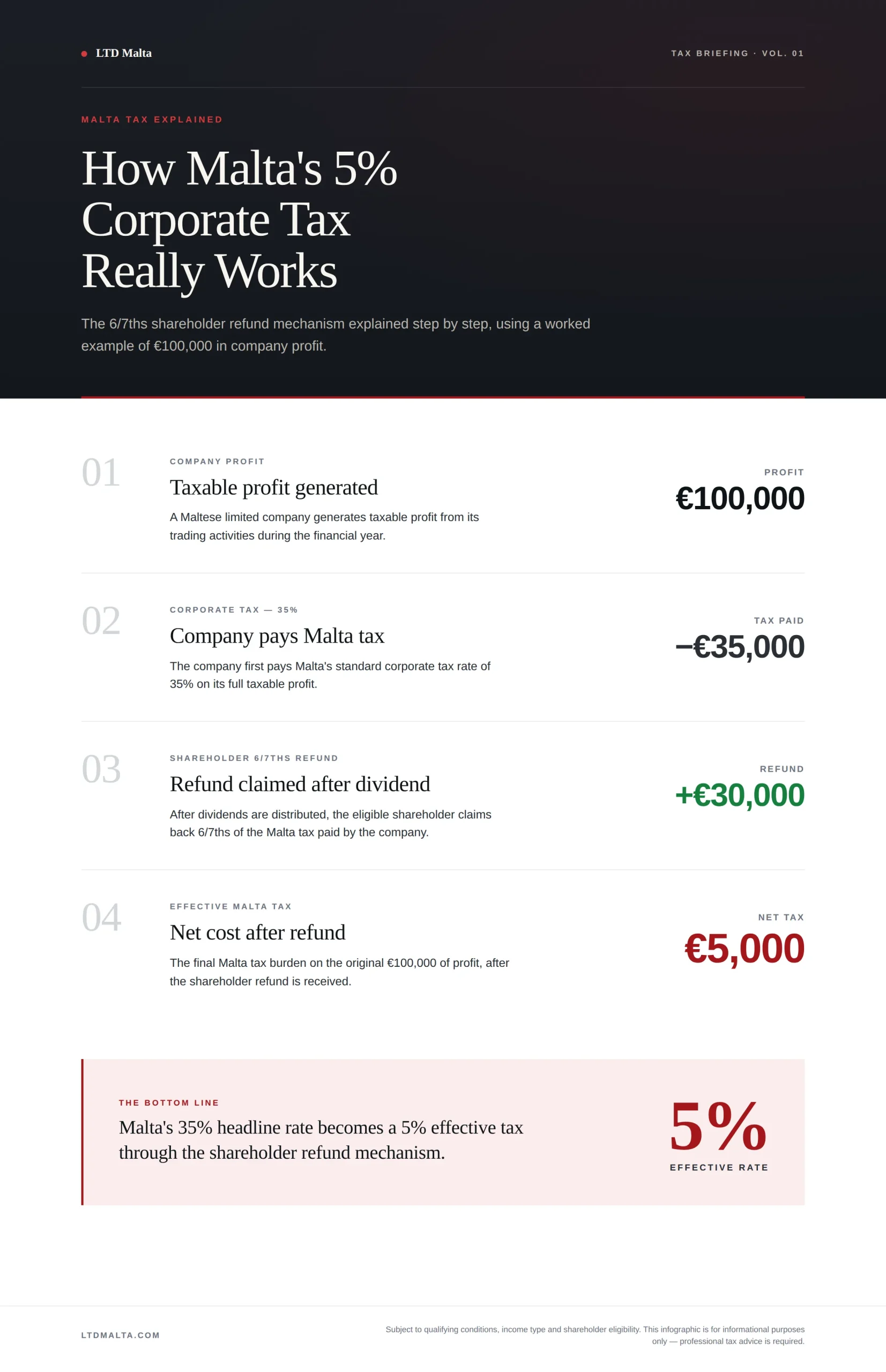
Simple Example: How the 5% Effective Tax Rate Is Calculated
Let’s take a simple example.
A Maltese company makes €100,000 profit.
The company pays Maltese corporate tax at 35%.
- Company profit: €100,000
- Corporate tax at 35%: €35,000
- Profit available for dividend distribution: €65,000
If the shareholder is entitled to a 6/7ths refund, the refund is calculated on the tax paid by the company.
- Tax paid: €35,000
- 6/7ths refund: €30,000
- Net tax cost in Malta: €5,000
So the effective Malta tax cost is:
€5,000 on €100,000 profit = 5%
This is why Malta is commonly described as offering a 5% effective corporate tax rate. However, it is important to understand that the company initially pays 35%, and the effective 5% result is obtained only after the shareholder refund process.
What Is the 6/7ths Tax Refund?
The 6/7ths tax refund is the refund most commonly associated with Malta’s 5% effective tax rate.
It generally applies to profits derived from active trading activities, such as:
- service businesses,
- consulting companies,
- international trading businesses,
- e-commerce businesses,
- technology companies,
- certain commercial operating companies.
The refund equals 6/7ths of the Malta tax paid by the company. Since the company pays 35% tax, 6/7ths of 35% equals 30%.
That leaves a final Malta tax cost of 5%.
- 35% corporate tax paid
- minus 30% shareholder refund
- equals 5% effective tax
Important: The Company Pays 35%, Not 5%
This is one of the most important points for business owners to understand.
A Malta company does not normally just pay 5% tax directly.
The standard flow is:
- The company pays 35% tax.
- Dividends are distributed.
- The shareholder claims a refund.
- The net tax cost may become 5%.
This has practical cash-flow implications.
For example, if the company makes €100,000 in profit, it may first have to pay €35,000 in tax before the shareholder refund is received. Depending on the timing, this can affect liquidity and planning.
For this reason, tax planning in Malta should not only consider the final effective rate, but also:
- cash flow,
- refund timing,
- dividend distribution,
- shareholder structure,
- compliance costs,
- banking requirements,
- substance requirements.
When Is the 5% Effective Tax Rate Available?
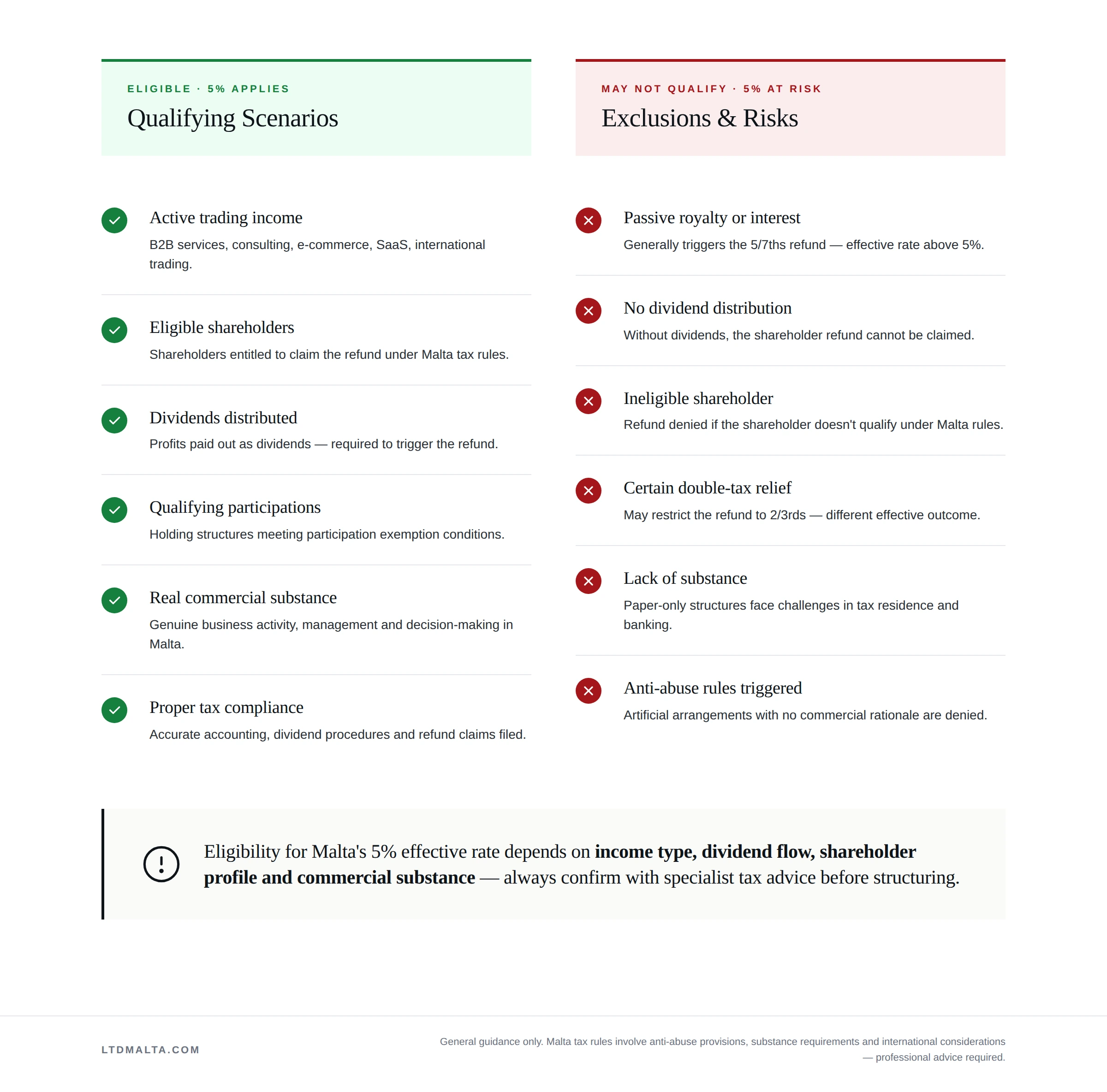
The 5% effective rate is most commonly associated with Maltese companies carrying out active trading activities, where the shareholder qualifies for the 6/7ths refund.
Typical examples may include:
- international consultancy businesses,
- B2B service companies,
- software and SaaS companies,
- online trading businesses,
- import/export companies,
- digital businesses with real commercial activity.
However, eligibility depends on the specific facts of the company, its income, its shareholders, and the applicable tax rules.
The 5% effective rate should not be assumed automatically. Professional tax advice is essential before setting up a company or restructuring an existing business.
What Types of Refunds Exist in Malta?
The 6/7ths refund is the most widely discussed, but it is not the only refund available under Malta’s tax system.
Depending on the type of income and the circumstances, shareholders may be entitled to different refunds.
6/7ths Refund
This is the most common refund and is generally associated with trading income.
It can result in an effective Malta tax rate of around 5%.
5/7ths Refund
This may apply in cases involving certain passive interest or royalty income.
In this case, the effective tax rate is usually higher than 5%.
2/3rds Refund
A 2/3rds refund may apply where the company has claimed certain forms of double taxation relief.
This can change the effective tax outcome.
Full Refund
In some cases involving qualifying participating holdings, shareholders may be entitled to a full refund of Malta tax paid, where the relevant participation exemption rules and conditions apply.
Does the 5% Tax Rate Apply to All Malta Companies?
No.
The 5% effective tax rate does not automatically apply to every Maltese company.
It depends on several factors, including:
- the type of income generated,
- whether the income is trading or passive,
- whether dividends are distributed,
- whether the shareholder is eligible for a refund,
- whether double tax relief has been claimed,
- the tax residence of the shareholder,
- the company’s structure,
- substance and commercial activity,
- anti-abuse rules and compliance requirements.
For example, a company earning passive royalties may not fall under the standard 6/7ths refund. A company that does not distribute dividends may not trigger the shareholder refund process immediately. A company with certain types of international tax relief may also have a different effective tax result.
Does the Shareholder Need to Be Non-Resident?
Malta’s tax refund system is commonly used in international structures with non-resident shareholders. However, the refund system may apply to both resident and non-resident shareholders in respect of Malta tax borne by the company, subject to the applicable rules.
That said, the overall tax result for a shareholder will also depend on the tax laws in the shareholder’s country of residence.
For example, even if Malta grants a refund, the shareholder may still have tax obligations in another country. This is especially important for entrepreneurs who live outside Malta or who manage the company from another jurisdiction.
Is the 5% Rate Final?
From a Malta perspective, the refund mechanism may reduce the Malta tax cost to 5% in qualifying cases.
However, this does not always mean that the overall global tax burden is only 5%.
The final tax outcome may depend on:
- where the shareholder is tax resident,
- where the company is effectively managed and controlled,
- whether the company has real substance in Malta,
- whether controlled foreign company rules apply,
- whether the shareholder’s country taxes dividends or foreign company profits,
- whether double taxation treaties are relevant,
- whether anti-avoidance rules apply.
This is why Malta company formation should be considered as part of a proper international tax analysis, not just as a way to access a headline effective rate.
Malta’s Full Imputation System Explained
Malta operates a full imputation system.
In simple terms, this means that when a Maltese company pays tax on its profits, that tax is imputed to the shareholder when profits are distributed as dividends.
The purpose is to avoid economic double taxation of the same profits: first at company level and again at shareholder level.
This is the foundation of the refund system.
- The company pays tax.
- The shareholder receives a dividend.
- The shareholder is credited for the tax already paid by the company.
- The shareholder may claim a refund of part of that tax.
Why Does Malta Use This System?
Malta’s corporate tax system is designed differently from many jurisdictions.
Instead of applying a low corporate tax rate directly, Malta applies a high headline rate of 35%, combined with a refund system for shareholders.
This has historically allowed Malta to offer an attractive effective tax result while maintaining a formal corporate tax rate aligned with its domestic tax framework.
The system is part of Malta’s broader positioning as an EU jurisdiction for international business, holding companies, trading companies and investment structures.
Practical Timeline: When Is the Refund Claimed?
The tax refund is generally linked to the distribution of dividends.
A simplified timeline looks like this:
- The company prepares accounts.
- The company calculates taxable profits.
- The company pays Malta corporate tax.
- The company distributes dividends from taxed profits.
- The shareholder submits a refund claim.
- The tax refund is processed and paid to the shareholder.
The exact timing can vary depending on the company’s accounting period, filing deadlines, documentation, tax payment timing and administrative processing.
From a business planning perspective, this means that the 5% effective result is not always immediate unless a specific structure, such as a tax consolidation or fiscal unit arrangement, is available and appropriate.
What About Fiscal Units and Tax Consolidation?
Malta also has a tax consolidation regime, commonly referred to in practice as the fiscal unit system.
Under certain conditions, a group of companies may be treated as a single taxpayer for income tax purposes. This can help reduce the cash-flow disadvantage of the traditional refund system because, in some cases, the group may effectively pay the net tax amount rather than first paying 35% and later waiting for a refund.
This is a more technical area and usually applies to group structures that meet specific ownership and eligibility requirements.
For smaller companies or individual entrepreneurs, the traditional company tax and shareholder refund mechanism remains the key concept to understand.
Does Malta’s 5% System Still Exist in 2026?
Yes, the Malta tax refund system is still widely used and discussed in current Malta corporate tax guidance. The 35% headline tax rate and the 6/7ths refund mechanism remain central elements of the Maltese corporate tax system.
However, Malta’s tax environment continues to evolve, especially in relation to international tax standards, substance requirements, OECD initiatives, EU rules and optional regimes.
This does not mean that every company must use the same structure, but it does show why businesses should obtain updated advice before choosing a tax setup.
Who Can Benefit Most from Malta’s 5% Effective Tax System?
The Malta 5% effective tax system may be relevant for:
- international entrepreneurs,
- foreign shareholders,
- consulting businesses,
- software companies,
- e-commerce companies,
- trading companies,
- holding structures,
- groups with international operations,
- businesses looking for an EU company structure.
However, Malta is not suitable for every business.
A Malta company should have a real business purpose, proper management, accurate accounting, adequate compliance, and a structure that makes sense commercially. If you are comparing Malta with other jurisdictions, see our detailed comparison: Malta vs Dubai: Tax and Company Formation.
Substance Requirements: Why They Matter
Modern tax planning is no longer based only on where a company is incorporated.
Authorities increasingly look at substance, management and control, decision-making, people, premises, activities and risk.
A Maltese company may be stronger from a tax and compliance perspective if it has:
- real commercial activity,
- proper board decisions,
- local registered office,
- clear accounting records,
- documented business operations,
- contracts and invoices aligned with the company,
- economic rationale for being established in Malta.
Depending on the business model, additional substance may be required or advisable.
A company that exists only on paper, with no real activity or commercial purpose, may face challenges in banking, tax residence, international reporting and anti-abuse analysis.
Banking and the 5% Tax System
Opening a company in Malta and accessing the 5% effective tax system are not the only issues to consider.
Banking is often a major practical step.
Banks and electronic money institutions may ask for:
- shareholder identification,
- source of funds,
- business plan,
- contracts,
- expected turnover,
- countries of operation,
- tax residence information,
- proof of activity,
- ownership structure,
- compliance documentation.
Even if the tax structure is valid, the company still needs to satisfy banking and KYC requirements.
This is especially relevant for foreign-owned companies, online businesses, high-risk sectors, crypto-related businesses, financial services, gaming, and companies with complex ownership structures.
Common Misconceptions About Malta’s 5% Tax
Misconception 1: “A Malta company simply pays 5% tax”
This is not accurate.
The company normally pays 35%. The 5% effective result comes after the shareholder refund.
Misconception 2: “Every Malta company qualifies”
Not every company qualifies for the same refund. The result depends on the income type, shareholder eligibility and applicable rules.
Misconception 3: “The 5% rate is always immediate”
In the traditional system, the company pays tax first and the shareholder claims the refund after dividend distribution.
Misconception 4: “The 5% Malta tax is the only tax to consider”
The shareholder’s country of residence may tax dividends or foreign income. International tax rules must always be checked.
Misconception 5: “No substance is needed”
This is risky. Substance, management and genuine commercial activity are increasingly important.
Example: Trading Company with Foreign Shareholder
Let’s consider a simple international trading company.
A non-resident entrepreneur sets up a Maltese limited company. The company provides B2B consulting services to clients in Europe.
At the end of the year, the company generates €200,000 in taxable profit.
The Maltese company pays 35% corporate tax:
- Profit: €200,000
- Tax at 35%: €70,000
- Net after tax: €130,000
The company distributes the after-tax profit as a dividend.
The shareholder claims a 6/7ths refund of the tax paid:
- Tax paid: €70,000
- 6/7ths refund: €60,000
- Final Malta tax cost: €10,000
The final Malta effective tax rate is:
€10,000 / €200,000 = 5%
However, the shareholder must also check tax obligations in their own country of residence.
Example: Passive Royalty Income
Now consider a company earning passive royalty income.
In this case, the standard 6/7ths refund may not apply. A 5/7ths refund may apply in certain cases of passive interest or royalties, producing a different effective result.
This means that the tax result could be higher than 5%.
This is why it is important to classify income correctly before assuming the 5% effective rate applies.
Compliance Requirements for Malta Companies
To benefit from Malta’s corporate tax system, a company must remain compliant.
Typical compliance obligations may include:
- annual accounts,
- corporate income tax return,
- company annual return,
- bookkeeping records,
- VAT registration and VAT returns where applicable,
- payroll compliance where employees are involved,
- beneficial ownership reporting,
- proper invoicing,
- audit requirements,
- tax refund documentation.
A Maltese company should not be viewed only as a tax-saving tool. It is a real company with ongoing legal, accounting and tax obligations.
Advantages of the Malta Tax Refund System
Malta’s corporate tax system may offer several advantages:
- potential 5% effective tax rate on qualifying trading income,
- EU jurisdiction,
- full imputation system,
- wide use for international business structures,
- refund mechanisms for shareholders,
- possible holding company benefits,
- access to professional corporate services,
- English-speaking business environment,
- legal system influenced by both civil law and common law traditions.
For the right business, Malta can be a strong jurisdiction for company formation and international operations.
Disadvantages and Practical Considerations
There are also important limitations and costs to consider:
- the company initially pays 35%,
- refunds require correct dividend and tax procedures,
- cash flow must be planned,
- compliance costs apply,
- banking can be demanding,
- substance may be required,
- international tax rules may affect the final result,
- not all income qualifies for the same refund,
- tax advice is essential.
For some entrepreneurs, a Malta company may be highly efficient. For others, a simpler domestic structure may be more appropriate.
Is Malta a Tax Haven?
Malta is sometimes described as a low-tax jurisdiction because of the shareholder refund system. However, Malta is an EU Member State with a formal corporate tax rate of 35%, tax reporting obligations, company law requirements, AML rules, VAT rules and regulatory oversight. Notably, Malta does not appear on the EU list of non-cooperative jurisdictions for tax purposes maintained by the European Commission.
The effective 5% tax outcome is not a hidden tax exemption. It is based on a formal imputation and refund mechanism.
That said, Malta’s system has attracted international attention and debate because of the difference between the headline 35% rate and the possible 5% effective outcome for certain shareholders.
A business should therefore use Malta for legitimate commercial, operational and tax planning reasons, not for artificial arrangements.
Malta 5% Tax: Key Takeaways
- Malta’s official corporate tax rate is 35%.
- The commonly discussed 5% effective tax rate is usually achieved through the shareholder tax refund system.
- For active trading income, the most common refund is the 6/7ths refund.
- The company normally pays 35% tax first.
- The shareholder may claim a refund after dividends are distributed.
- The effective Malta tax cost can become 5% in qualifying cases.
- The 5% effective rate does not automatically apply to every company.
- Income type, shareholder profile, double tax relief, substance and international tax rules all matter.
- Professional advice is essential before setting up a Malta company.